
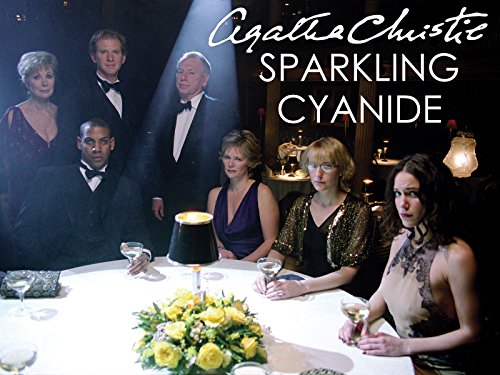
There’s something about a British murder mystery that just hits the spot so nicely. My husband and I have recently taken it upon ourselves to watch all of Agatha Christie’s works that have been adapted into either screenplays or TV shows. After finishing all of Poirot and Miss Marple (highly recommend), we found ourselves delving into her standalones, which brings us to today’s review of Sparkling Cyanide (2003).
Sparkling Cyanide involves the death of Rosemary Barton (Rachel Shelley), the young wife of a wealthy and powerful soccer team manager, George Barton (Kenneth Cranham). While out to dinner with family and friends, she dies immediately after toasting champagne, hence “sparkling cyanide.” All of the guests are suspects, including her husband, George, her sister, Ivy, her sister’s boyfriend, Carl “Fizz” Fitzgerald (Justin Pierre), Rosemary’s aunt Lucilla Drake (Susan Hampshire), and a young politician, Stephen Farraday (James Wilby). Our detectives are Colonel Geoffrey Reece (Oliver Ford Davies) and his wife, Dr. Catherine Kendall (Pauline Collins), sweet grandparents who double as secret government agents. As they unpack the motives behind each of the suspects, George is suddenly poisoned, and we learn that there is much more to the mystery than we initially assumed.
Because Sparkling Cyanide is a mystery, I do not want to spoil the ending. If you really want to know how it ends without watching it, you can find a summary online elsewhere. Here at The Legionnaire, our focus is on providing a Catholic perspective to a film review, and I can speak to that perspective without spoiling the ending in this case.
I have not read Christie’s original rendering of Sparkling Cyanide, but apparently this screenplay makes many changes as it attempts to modernize the plot and characters. One of these alterations is revealing that Rosemary had an abortion prior to being murdered. As a Catholic who values all human life, this was an unfortunate addition for me.
The intent behind adding the abortion subplot was to add motive to some of the characters, but this could have been accomplished with a miscarriage (which still would have been heartbreaking, by the way). Further, the use of abortion in this story was particularly sad because Rosemary was actually undergoing fertility treatments and trying to become pregnant. I guess, in that sense, I’m grateful that abortion wasn’t glorified in the same way that it can be in popular culture. Abortion is a deeply tragic choice that most women do not want to have to make, and it was portrayed this way in the movie. Unfortunately, it is never sufficiently explained why Rosemary terminated her pregnancy since she had wanted a child so desperately. That may have brought more closure to an unsettling storyline.
As Catholics, we know the importance of defending the inherent value of human life. We are called to protect the most vulnerable, but something we sometimes forget about is that we are also called to love, not villainize, the women who make the heartbreaking decision to have abortions. They need our prayers (and help) the most. Sparkling Cyanidedepicts Rosemary as a very broken woman who is deeply suffering, and I’m sure that having an abortion only added to that brokenness.
Overall, this is an engaging, albeit dark, film. If you enjoy murder mysteries, you’ll probably enjoy this one, but it is definitely not an uplifting film.
 The Legionnaire