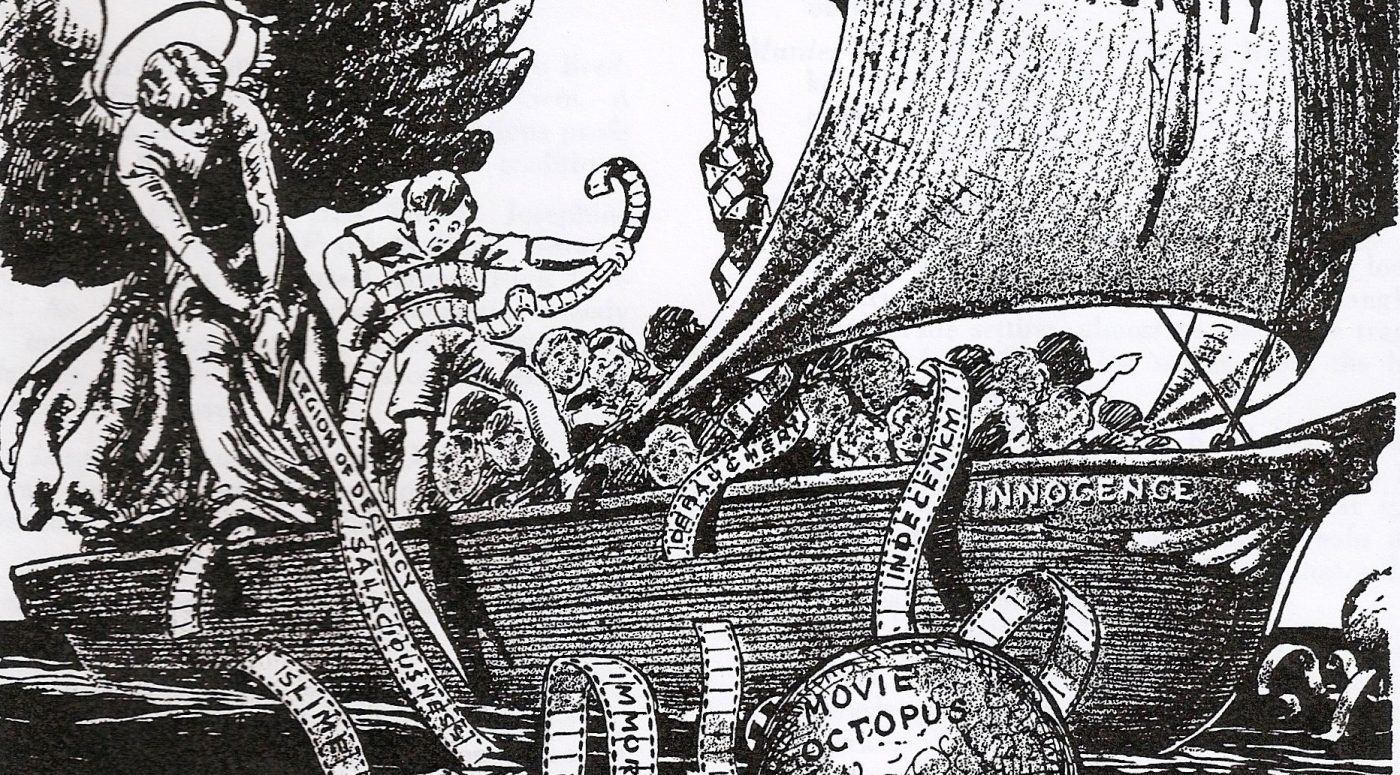
There are more culturally degrading films than Road to Zanzibar (1941), though it is not as bad as some of the more self-consciously racist pictures around. Much of how I got into reviewing movies revolves around noticing such details. You can read more about my thoughts on how this affected the way Catholicism has been portrayed in American cinema by taking a look at my dissertation, The Costumed Catholic: Catholics, Whiteness, and the Movies, 1928-1973. One of the main features I use for explaining the way in which certain groups were filmed revolves around the Production Codes. They were a set of guidelines, written by a Jesuit priest, that the major Hollywood studios adopted in the 1930s. If certain criteria were not met, as determined by the Production Code Administration (PCA), then the companies making these flicks agreed not to distribute them to the theaters. The language of these rules adhered to a set of stereotypes that, unfortunately, were prominent at that time. Occasionally, we try to explain away the bigotry of the past by telling ourselves that is just how people were back then, as if that is a real justification. There were concurrent voices offering an alternative point of view on those matters, but seldom did anyone listen. The safer bet was to not challenge social mores, and that by and large is what you will see in today’s example.
As is seemingly usual with this series, Bob Hope’s Hubert “Fearless” Frazier and Bing Crosby’s Chuck Reardon are two con men in Road to Zanzibar. In this instance, they are in the perfect place for such shenanigans: the circus. Chuck is the front man for pulling stunts on the unsuspecting public, and Fearless is the one risking his body. Their audience is wherever they are in Africa. They have to make a hasty get away, however, when the flaming dummy they launch out of a cannon lights the big top on fire, and the whole area begins to burn. From there, they run a whole series of side shows designed to part people from their money. It is Fearless that is taking all the bumps and bruises, and after a little while he has decided that he wants to return to the United States. He feels that the thousands of dollars they have made from their shows are enough to get him back to America. Chuck wants to keep working, but eventually relents and offers to purchase tickets on the next boat across the Atlantic. Instead, Chuck runs into Charles Kimble (Eric Blore), a wealthy eccentric who bails them out of jail. I say “eccentric” because, while it was a Christian thing of Charles to see to Chuck and Fearless’ release, Charles also sweettalks Chuck into buying a defunct diamond mine. Chuck excitedly brings the news to Fearless. Instead of being thrilled, Fearless is devastated that they now have no money to return home, and angrily stalks away. When he comes back to their room, he happily informs Chuck that he has regained their funds and that it is time to go. Before they can pack, the one whom Fearless ripped off pays them a visit, bringing along some muscle and demanding that Chuck and Fearless accompany him into the jungle to the supposed source of the gems. Once more they are forced to escape. Their flight takes them past a window where Julia Quimby (Una Merkel) is imploring passersby for help. Chuck and Fearless play the Good Samaritan and offer their assistance. Julia asks that they use their evident funds to buy her friend, Donna LaTour (Dorothy Lamour), who is about to be sold at a slave auction. Like I said in the introduction, not great. Once they secure her release, we come to learn that Donna and Julia are hucksters themselves. Donna in particular uses her womanly wiles to get the two well-funded Americans to escort them into the jungle, paying for an unfortunate number of local porters. As they go along, Chuck and Fearless begin to vie for primacy in Donna’s affections, each one thinking he is the one picked by her based on time spent with her. It is Julia that finally clears the confusion, telling them they are on their way to Donna’s true fiancé, some kind of wealthy merchant named Bradley (not pictured). Chuck and Fearless are not happy about being duped, and angrily send the women off, but with all their money. Now Chuck and Fearless have to find their way back to civilization on their own, which predictably does not go well. Not long into their wanderings, they happen upon the ruins of village that had seemingly been massacred. Because this is supposed to be a comedy, they decide to start beating on the drums they find left behind. A nearby group of tribesmen hear the noise and come to investigate. At first, there is a debate as to whether Chuck and Fearless are gods. Fearless’ brawl with a gorilla (or a man in a gorilla suit, anyway) proves their lack of divinity. Thus, it is the cooking pot for them. What saves them is their “patty-cake” routine they do before starting a fight, which seems to amuse the people immensely. Again, this is not flattering for Africa. In the ensuing commotion, Chuck and Fearless slip away. Judging from their beards in the next scene, they had been gone weeks, but they make it back to civilization, though with no money. Actually, Fearless has the gold necklaces given them when they were taken as gods. Once more, it is Chuck who is put in charge of securing their passage home. Instead of steamer tickets, he returns with Donna and Julia, the former having decided not to marry Bradley. Rather, she is in love with Chuck, and together they start performing shows to obtain the money to sail to the United States.
As Road to Zanzibar unfolded before my eyes, I thought that perhaps it was not going to be as stereotypical as I presumed. Then we got to the sequence with the African villagers. I suppose this pays off the stylized African tribesmen seen in the opening credits, rendered with outrageously large lips. Such ideas are counter to Catholic thinking on the dignity of the person. This is out of phase with the fact that a priest penned the Production Codes, and I do not wish to excuse what he did as simply being par for the age. When Catholics do things contrary to Church teaching, that cannot be explained away, no matter the context. And to be fair, though it might not always seem that way, the leadership owns up to mistakes. The larger context here is that, sad as it is to say, one cannot expect the ideal to be portrayed from Hollywood at this time. Father Daniel Lord, the Jesuit in question, or his friend, fellow Catholic, and head of the PCA, Joseph Breen, grew up in a country with sensibilities that do not match our own today. Had they followed Catholicism more closely, they would not have allowed films like this one to be produced. At the same time, this series was successful, starring some of the biggest names of the 1940s, enough to warrant seven of them. They were appealing to the masses with this material, and because of this you once more you have a dilemma for Catholics in the United States. My dissertation explores this, too, but suffice to say that our Faith has not always been popular. Yet, by the twentieth century, it was the largest Christian sect in the United States. I say all this in order to explain why you get content like you do in today’s movie. Anything that would have been more Catholic in nature would have appeared foreign to broader audiences, and that is not a risk they wanted to take.
As I conclude this review of Road to Zanzibar, I hope that I will not be saying similar things about the rest of them. Crosby and Lamour were Catholic, and Hope converted to the Faith late in life. As such, they should have known better in the 1940s than to engage in such awfulness. It makes for an imminently skippable entry in this series.
 The Legionnaire