Recently, I discovered a new film to add to my list of favorites: Hundreds of Beavers (2022). It is a silent, black and white comedy. For reasons obvious and beyond my understanding, people do not enjoy this brand of moviemaking. I cannot blame them for wanting to hear the performers deliver their lines, and color is nice, too. Alternatively, if this speaks to your cinematic tastes, you are missing out on some fun movies. If I have managed to describe you as a film goer, then might I suggest going back to the 1920s and the era when silent productions were the only mode by which the industry gave us their work. Most will tell you to watch anything with Charlie Chaplin, and this advice makes sense. I cannot deny his talent. If you ask me, or I will just tell you since this is my blog, I would point you towards Buster Keaton. I have seen a few of his motion pictures now, and his brand of physical comedy is more audacious than Chaplin. Because of this, I am delighted to tell you about Steamboat Bill, Jr. (1928).
A title like Steamboat Bill, Jr. might make you think of Mickey Mouse, who first appeared (and was inspired by the former) in the same year in Steamboat Willie (1928). Steamboat Bill, Jr. is actually William “Bill” Canfield, Jr. (Buster Keaton), son of Captain William Canfield (Ernest Torrence), skipper of the aging (and unfortunately named) paddlewheel vessel the Stonewall Jackson. The movie opens with the Stonewall Jackson pulling into the city of River Junction at the same time as the better funded and more modern ship operated by John James “J. J.” King (Tom McGuire). Captain Canfield and J.J. are bitter rivals. J.J. is coming to River Junction, a town that he seems to practically own since his name is on most of the businesses, to meet his daughter, Kitty King (Marion Byron). She is visiting from school. Captain Canfield is there for roughly the same reason, though for him it is to make contact after years of being away from Bill, his son whom he has not seen since Bill was a child. It had been Bill’s mother’s wish that father and son be reunited. Captain Canfield is excited to become reacquainted with Bill, but is not impressed with the young man upon their laying eyes on him. Captain Canfield expects a large, rugged individual like himself. Instead, Bill is foppish and used to Bostonian ways. As Captain Canfield tries to prepare Bill for life aboard his steamer, Bill and Kitty spot each other. They were sweethearts back east, and believe they will carry on here in River Junction. Unsurprisingly, Captain Canfield and J.J. do not approve of them consorting with one another. Once Bill’s clothing is sorted, looking more officer-like thanks to Kitty’s intervention, they try to board each other’s boats, only to be met with hostility from Captain Canfield and J.J. That night, Kitty manages to get a note to Bill asking that he come to her by 8:00 pm if he cares for her. He attempts to go to sleep with his clothes on to streamline the process, but the ever-vigilant Captain Canfield spots the ploy and makes his son change. Bill complies, but still manages to slip out the window. As he tries to make his way onto the other ship, a series of comedic things happen that prevent them from being together that night. Further, Captain Canfield checks on Bill one more time and discovers his son is out of bed. Having had enough of Bill’s antics, Captain Canfield has a ticket home waiting for Bill in the morning, along with some money to see him through the trip. When Captain Canfield walks to the end of the pier to which the Stonewall Jackson is moored, he finds a notice of condemnation for his vessel. Blaming J.J., Captain Canfield goes to confront the businessman and a fistfight ensues. When the police arrive on the scene, J.J. points the finger at Captain Canfield, and has the latter put behind bars. Bill sees this happen and opts to stay. The next day, as a storm begins to pelt River Junction with rain and wind, he makes his way to the jail to give his father some bread. At first, Captain Canfield stubbornly refuses his son’s help, but then Bill reveals that he has baked in tools to affect an escape. Unfortunately, the files and saws fall out of the hollowed loaf, and the sheriff goes to arrest Bill. With Captain Canfield’s encouragement, Bill knocks the officer out and frees his father. However, upon seeing J.J. pull up to the station, Captain Canfield goes back to his cell instead of risking getting his son into further trouble. Meanwhile, the tempest strengthens, sending the citizens of River Junction to seek shelter as buildings are being leveled by wind. There are some incredible effects to be seen in this sequence. Also incredible are Bill’s acts of heroism. After being tossed about town, he makes his way to the still afloat Stonewall Jackson. He rescues Kitty from a building going downstream, uses the ship to split open the jail that is also in the river, and then dives in to get J.J. from the wreckage of one of his boats. Everyone is thankful for his efforts, and willing to let bygones be bygones. With Kitty, she is confused and a little hurt when Bill jumps into the water following her congratulatory kiss. The matter is cleared up, though, when we see him swimming out to bring over a minister drifting past.
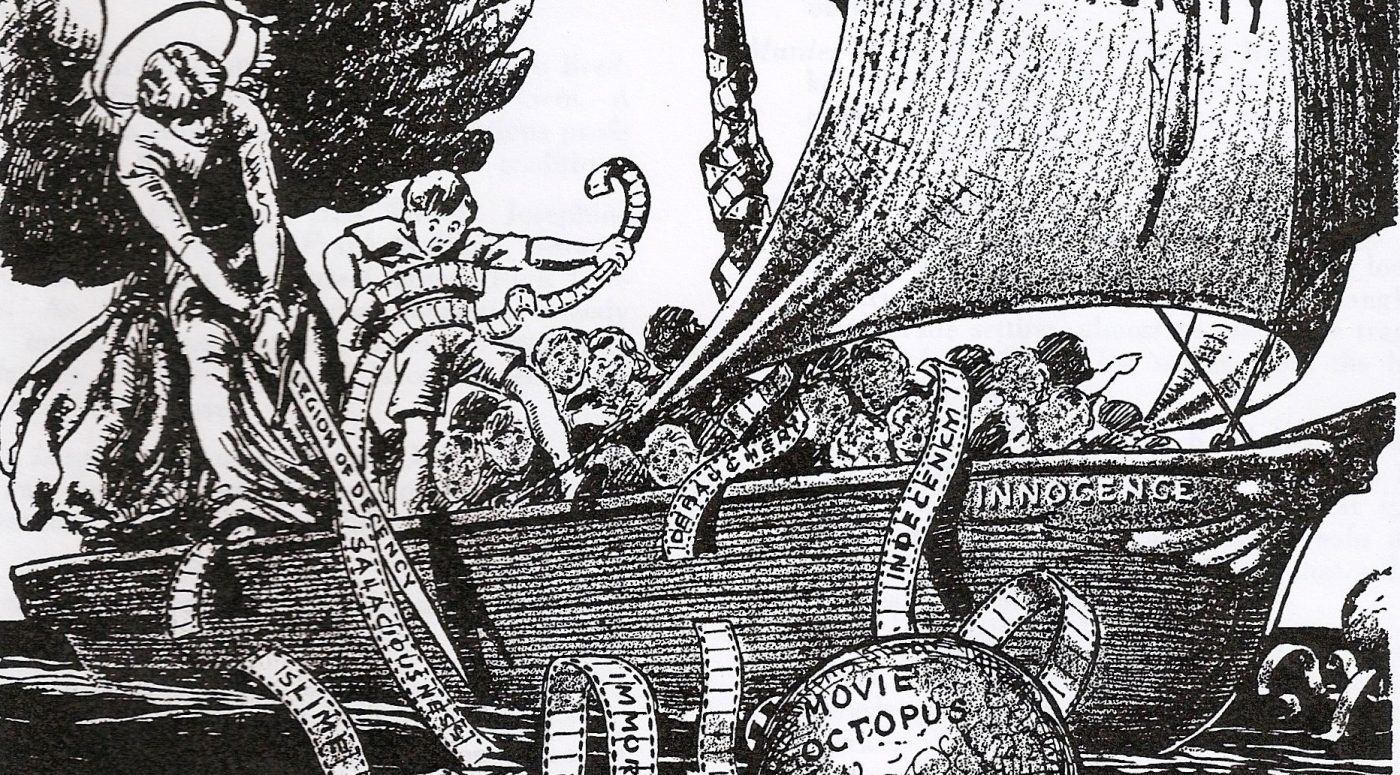
It is probably safe to assume that Steamboat Bill, Jr.’s final gesture is so that he and Kitty can get married. I have no idea if this person is meant to be a Catholic priest because the actor is not credited, at least that I can find. Nonetheless, it would not be a longshot to guess that he is meant to be a priest. The year this movie was released, 1928, was a transitional period for Catholicism in the United States. Anti-Catholic forces were on the rise, with this period being the height of the Ku Klux Klan’s power. With that, they were able to see the first avowed Catholic to run for president, Al Smith, soundly defeated. At the same time, Catholic influence on Hollywood began to flourish. Father Daniel Lord, a Jesuit priest, penned what would become known as the Production Codes, a series of guidelines the film industry followed for many decades for making movies. Though they are more often referred to as the Hays Code, named after William H. Hays, the first chairman of Motion Picture Producers and Distributors of America (MPPDA), Catholicism played a part in their content and enforcement. Along with Father Lord, a group of other practicing Catholics, like industry trade magazine publisher Martin Quigley, formed the Legion of Decency. This organization was a Catholic cinema watchdog organization that, for many years, published recommendations on movies in parish bulletins across the country. Using their influence, they were able to get one of their number, Joseph Breen, to be the head of the Production Code Administration (PCA). The PCA, for a long time, exercised a lot of control over Hollywood content. Does any of this have to with Steamboat Bill, Jr.? Not really. My intent here is to contextualize what goes through the mind of this Catholic reviewer when I see a man of the cloth on screen in any movie, particularly one from the 1920s. I could have talked about Bill’s selflessness being a Christian virtue, which is true. However, I noted an undefined thread in what is otherwise an entertaining, and short, film. It is good to know the background of these things and understand the decisions behind putting a person dressed like a priest on the screen. Admittedly, he could be just a guy dressed like a member of the clergy. Yet, because of that costume, it is meant to signal something without having to explain it. Now I have done that, and I consider that to be doing my job.
It is no chore to watch Steamboat Bill, Jr. As I mentioned in the previous paragraph, it is short, clocking in at a little over an hour. Because of that, if you put it on and find you are getting bored, do not worry, it will be over soon. I do not think you will lose interest, though, because it is entertaining throughout.
 The Legionnaire