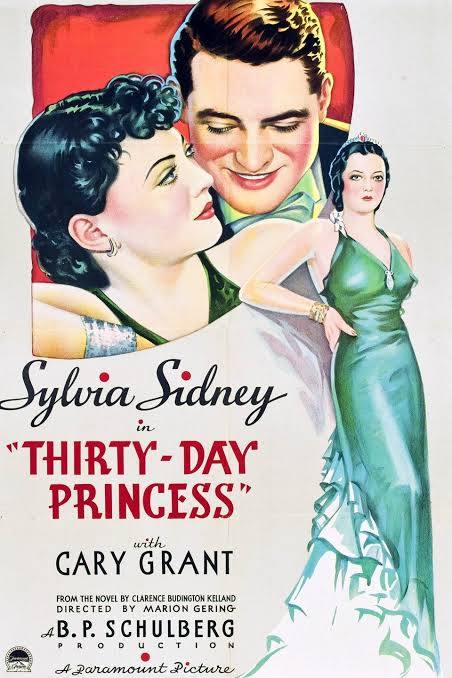
Another Cary Grant film review, and another fun movie-watching experience. I have to be careful, though, as there are a dangerously low number of his films left for me to discuss. This is only my way of saying, once again, how much I appreciate his work. I do not look at it the same way as I do my Faith. There are degrees to these sorts of things. The issue is that, after seeing so many flicks over the years, you learn to spot quality, and there is a lot of quality in this one. This one is Thirty Day Princess (1934), an early example of his work. It is short, sweet, and I look forward to telling you about it.
In the small, charming, but fictional European kingdom of Taronia, Thirty Day Princess begins with King Anatol XII (Henry Stephenson) hoping to improve his impoverished nation’s prospects. American financier Richard M. Gresham (Edward Arnold) proposes raising fifty million dollars through a bond issue to help modernize the country. He believes that a visit to the United States by the king’s daughter, Princess Catterina, known to her father as Zizzi (Sylvia Sidney), will generate the favorable publicity needed to make the plan succeed. One obstacle is Porter Madison III (Cary Grant), an influential New York newspaper publisher who distrusts Richard and opposes the financial scheme. Another problem appears when the princess contracts the mumps and must remain in quarantine for thirty days, just when Richard needs her to charm the American public. With the entire enterprise in jeopardy, Richard discovers Nancy Lane (also played by Sylvia Sidney), an unemployed actress who looks remarkably like Catterina. Nancy has little money and few prospects, so his offer of ten thousand dollars to impersonate the princess for a month is difficult to resist. He promises her an additional five thousand dollars if she can change Porter’s opinion of the bond issue. Nancy accepts and receives lessons in royal manners, family history, and the distinctive speech expected of a Taronian princess. The deception must fool not only the public but also the attendants and officials surrounding the visiting royal household. Once she appears as Catterina, Nancy finds herself the center of attention, with reporters and prominent citizens eager to meet her. She makes a particular effort to cultivate Porter, whose hostility to Richard’s proposal could undo the publicity campaign. Porter is intrigued by the supposedly aristocratic young woman, and, as he shows her around New York, their conversations become more personal than either Richard or Nancy anticipated. Beneath the royal performance, Nancy is warm, spirited, and far less constrained by ceremony than Porter expects. She, in turn, discovers that the man she was hired to influence is not merely a difficult newspaper publisher. Their attraction grows into genuine affection, even as Nancy realizes that the more Porter cares for her, the more painful the inevitable revelation will be. During an evening out, a fellow actor named Donald Spottswood (George Baxter) recognizes Nancy despite her disguise. When she refuses to acknowledge him, Donald becomes combative, and Porter intervenes by striking him. The incident attracts attention that threatens to expose the farce. Donald later seeks to identify the man who assaulted him, and detectives investigating the matter discover that Nancy has disappeared from her apartment. Her disappearance becomes a newspaper story, creating a dangerous connection between the missing actress and the visiting princess. Hoping to divert suspicion, Nancy visits Porter’s office as herself, adopting a noticeably less polished manner so that he will see her as an entirely different woman. Porter accepts her explanation, but one of his reporters remains suspicious. Nancy now has to keep the two identities separate while protecting the bond campaign and concealing her feelings. Her troubles multiply with the arrival of Count Nicholaus (Vince Barnett), Catterina’s uninspiring fiancé. Nancy is about to begin a goodwill tour across the country when the count appears and makes his claim on the princess unmistakable. Porter, who has fallen in love with the woman he believes to be Catterina, is devastated to discover that she is supposedly promised to another man. Feeling deceived, he angrily withdraws. Nancy refuses to take the count along on her tour, but his confusion over her behavior only strengthens the suspicions of Porter’s reporter. The count lets slip information suggesting that the woman appearing in public is not the real princess. By the time Nancy returns to New York, the genuine Catterina has recovered, and the two women finally meet. Rather than treating Nancy as an enemy, the princess befriends the actress who has spent the month living in her place. A final public reception offers the conspirators one last opportunity to escape exposure. The king arrives after being summoned by the suspicious reporter, apparently threatening to expose the entire scheme. But it is the real Catterina who presides over the ceremony and presents medals to Richard and Porter for their services to Taronia. Because the king sees his actual daughter before him, the accusation of impersonation collapses. When the king learns that Count Nicholaus helped create the scandal, he breaks off the count’s engagement to Catterina, much to her delight. Porter, however, still has to reckon with the discovery that the woman he loves is Nancy rather than the princess. Catterina assures him that Nancy’s feelings are sincere and points out that, had he actually fallen in love with royalty, marriage would have been impossible. Porter goes to Nancy, who demonstrates what matters most to her by tearing up the check she received from Richard. The film closes with them kissing.
The masquerade that is Thirty Day Princess begins as a business arrangement and ends with Nancy and Porter embracing, their affection finally free of the deception that brought them together. It is always good to begin a relationship, no matter whom it is with, on the basis of honesty. That is as true for a Christian as for anyone else. It is also good to be truthful about your circumstances, and for this I admire Nancy. Though she is part of a deception, she does not hide her lack of funds from her landlady or anyone else. There are those whose pride would force them to obscure their situation. Lord knows I have been guilty of the same behavior. If you are a Christian, however, doing so does not do justice to your faith. The poor, both materially and in spirit, were especially close to Jesus’ heart. It is also one of the core missions of the Catholic Church to minister to the destitute. It helps inform my own heart, and so when I see Nancy trying to feed herself on seventeen cents, it tugs at my proverbial heartstrings. What I do not love is seeing her steal a plate of food from a diner. As an aside, the establishment is called an automat, with its selections ready to eat behind windows you open by inserting a few coins. No matter what it is called, the Church does not simply dismiss the moral question of taking another person’s property. Catholic teaching does, however, recognize that in cases of evident and urgent necessity, taking what is needed for survival is not considered theft in the ordinary moral sense. That does not make Nancy’s predicament any less troubling. Instead of leaving people desperate enough to face such decisions, Catholics are encouraged to do what we can to address the conditions that lead to them. Unfortunately, we do not all get to play a member of royalty for a month or have a rich newspaper owner fall in love with us. God’s rewards are better.
You can do better with Grant’s movies than Thirty Day Princess, but I would still take it over the majority of other productions. Despite his reportedly not enjoying making the film, it is entertaining enough to make it worth your time.

